hi Friends,
Announcing my new venue for my weekly post, “Image of the Week”:
https://tinyletter.com/dyaelbernhard/archive
See you there!

D Yael Bernhard
 © Durga Yael Bernhard
Dead Sea Wadi is the image for February in my new calendar, The Jewish Eye 5779/2019 Calendar of Art.
A desert landscape is like another planet to me. The Judean Desert is especially severe – a landscape of both intensity and subtlety. Driving along the Dead Sea, I saw towering mesas, utterly dry, bereft of vegetation. The land was harsh and purifying, cruel and beautiful. Though I spent little time there, the environment made a deep impression on me.
This was a land of surprising polarities. The subtle outline of the hills of Jordan on the far side of the Sea, thin as veils – contrasting with the rough and wrinkled rocks with their dark cracks and bold shadows. The ancient stillness of the land paradoxically taking the form of wild organic shapes, with curves like calligraphy on burning paper. Once you start articulating these textures and shapes, they seem more like living coral than solid rock. Even the plants strangely resembled seaweed in this parched place that did not have a single cloud in the sky.
It was all so unfamiliar, I was terrified to start – even working in the comfort of my home from a photograph – taken by me while visiting Ein Gedi nature preserve in Israel. My photo reference for landscape painting is best when taken for that purpose, with an eye toward what will enable me to remember my vision of the place. I brought this one up on my computer screen with no idea how I would proceed beyond the first step. But before that step was completed, the second step revealed itself – and so on. One must cross a room before the door on the other side opens – a phenomenon I experience more in landscape painting than anywhere else. I never know how I will proceed – yet almost always, the way reveals itself as I go. I need only find one more step I can take.
As it turned out, this painting was one of the easiest landscapes I’ve ever painted. It slipped out with almost no effort, like a colt born in its caul. I never could have predicted that. The more I paint, the less I’m in control of what I do. Am I creating, or am I allowing something to create itself?
_______

Many painters are distinguished by their brushstrokes. From the pointillist dots of Seurat to the furious impasto of Van Gogh to the elegant gradients of O’Keeffe, many different styles come to mind. This personal choice of stroke and texture affects the entire appearance of an artist’s work. I’ve grappled with it for years, trying first one approach and then another.
About ten years ago, almost as if by a will of their own, my brushstrokes began to move in a diagonal direction. Always from lower left to upper right, there was no particular reason for it, but it felt intuitively right. Then I traveled to Israel for the first time, and spent two weeks of summer in Jerusalem, where I experienced the delightful evening breeze that brought relief from the heat of the day. I felt this breeze as a diagonal force that blew across the ancient city from the Judean Desert.
My ancient ancestors, the Hebrew people, were desert wanderers. They crossed the Negev and the Arava, the Sinai and Judean deserts. Knowing that Judaism itself was formed in the desert, it was easy for me to imagine this diagonal current as Ruach Elohim – the wind, breath, or spirit of God, or Creation – represented here as two hands that unfold from each other as earth and sky, with many colors in between.
Needing no further justification, I’ve used diagonal brushstrokes and direction in my work ever since, with that breath of life – and the peaceful evening breeze in Jerusalem – in mind. In this painting, it’s emphasized even more in the current that cuts across the entire composition – the rippling spirit of Creation.

I recently reread (or rather, listened to) James Michener’s epic historical novel The Source. This colossal work represents a lifetime of research and writing, yet it is only one of Michener’s books that follow a single place on earth through centuries of history. The Source begins in the Galilee 12,000 years ago, and ends in the 1960s. It begins with the birth of agriculture – and with it, the rise of a new pagan belief system.
I, too, have written and illustrated a work of historical fiction set in the Galilee: The Life of an Olive, my picture book that follows the 2000-year lifespan of a single tree, the history that unfolds in its valley, and the children who interact with it. I traveled to Israel four times to research this book, but it was my first reading of The Source that enabled me to understood the roots of religion – the beliefs of the ancient Canaanite farmers of the region, and precisely why they clashed with the desert nomads who were then known as Hebrews – meaning “donkey-riders” or “one from the other side”. The Hebrew people were wilderness nomads, lovers of open space and solitude, of travel and uncertainty, of land that knows no boundaries.
It is this insoluble conflict that erupts between Cain and Abel. Cain is a farmer, a town-dweller, living a settled life in a tightly-knit, walled community, cultivating crops in a fixed place, employing both technology and faith to bring forth the fruits of the earth. By contrast, Abel is a shepherd, eschewing land ownership to tend his flocks under open sky, finding his ancient god El Shaddai in his wanderings, belonging to no community other than the belief in one invisible, unknowable, intangible and universal god.
In the Book of Genesis, God states a clear preference for the fruit of Abel’s labors, both material and spiritual. This Cain cannot abide, though God gives him a choice: to give in to his angry jealousy that crouches in wait, or to transcend it. Cain crumbles, and strikes his brother dead.
Many people see this story as a conflict between vegetarian and meat-eater, but I see it as symbolic of the gap between two belief systems – a fascinating split in human nature. What grace, then, is represented by the child who heals this split! To understand the gift of Seth’s birth is to understand the duality into which he was born. If Cain and Abel are two sides of a coin, then what is Seth but the divine resolution that brings them together?
My own third child came into my life like a gift from God after the conflict of divorce. With her, my life began anew. How many of us have felt the renewal of a new baby entering our lives? Even if it’s not our own baby, we cannot help but find hope in new life. I congratulate Adam and Eve on their third child, their renewed hope, and the promise given to all of us that there is something beyond an intractable schism. I celebrate the birth of Seth and all that he stands for. He might even be our most distant Hebrew ancestor. Go Seth! You are born of goodness, healing, and the hope of resolution.

Transparent, overlapping shapes are an ongoing theme in my work. Yet oddly, I’ve never been able to repeat how I do it. In every case, a pattern cuts across a larger shape . . . but since they’re always different, I seem to have to invent a new technique each time. A wall of color blocks, harkening to the Kotel (the Western Wall in Jerusalem), provides the pattern for this painting. I cannot quantify how much trial and error went into each and every block. Long hours of mixing and applying different colors, different tones – first to create a common likeness among the three shapes, then distinction . . . then more likeness, followed by more distinction. The painting itself dictated my color choices, if only I would watch closely for what looked right. The bottom layer of background had to be pale yellow, I was sure of that. I am a servant, I thought as I obeyed. How ironic, to feel that way while painting an image that is so contrived, a product of my own will. Was I dabbling in a world of my own making, or was that world dabbling with me?
For me, the eye at the center of the painting – which I left as white canvas – was the most intriguing part. Like the peaceful eye of a hurricane, like the pure white that contains all the colors of the rainbow, there was no tension there, no grappling with what I should articulate. As the underlying oneness behind all Jewish tradition, this central eye must be blank – for I imagine it as the place where the unknowable Source resides, the unutterable name that transcends language. This empty eye symbolizes something that is both universal and individual. What resides there for you, at the center?
Many a winter morning was taken up by this painting, working for short spells, stealing ten minutes here, twenty there. It was on my mind – and propped up on a kitchen chair – for many weeks. Now months later, new versions of this concept are already springing up like wild grass. A new pattern emerges, this time with mid-tone lines along each row of color . . . a deliberately discordant palette . . . new shapes with wider curves and angles. When will I ever find the time?

This acrylic painting is part of a series of works on paper that illustrate the Book of Genesis. Several were in my calendar last year. The Birth of Seth, also in this year’s calendar, is another example. Each painting begins with a tonal “brush drawing” in dark brown, and is completed with washes of color in an earthy palette.
I love the story of Joseph. It comprises the best and the worst of human nature, teaching us how to be and how not to be; how family dynamics ebb and flow between trust and betrayal; how people learn – or fail to learn – from their mistakes. In the passage of Torah depicted here, Joseph grapples with his deepest childhood wounds even as he struggles to embrace the brothers who inflicted those very same wounds. How I understand that inner angst! For I have had a rocky relationship with my own sister all my life. I chose this moment in the story to illustrate because although my sister didn’t throw me into a pit or sell me as a slave, I felt emotionally cast away as a child. Years later, I know what it’s like to feel torn by ambivalence.
Two friends in my life have recently lost their brothers. I’ve never had a brother, but I do know the gaping hole left behind when a loved one departs. In the story of Joseph, his brothers take him to be dead for many years before they discover he is not only alive and well, but helping to rule the land to which he was banished as a slave! I might have chosen to paint this moment of revelation, and the brothers’ speechless astonishment, instead. Would that my two friends could be granted such a twist of fate . . . alas, it is not to be so. But those who grieve are not alone. The Torah amplifies our losses and longings – for in many ways, they are our own, even three thousand years later.

It wasn’t until after I painted Etz Chaim that I realized the influence of medieval art on my latest version of the Tree of Life. Three years ago, I had studied medieval Jewish illuminated manuscripts while writing a review of a prodigious book on the subject titled Skies of Parchment, Seas of Ink. This elegant and voluminous work gave me an in-depth understanding of the architecture of an illuminated manuscript – yes, architecture, constructed by a whole team of artisans to create a portable compendium of history, legend, family archive and political commentary – all bound up small enough be carried away in a pogrom or other anti-Semitic attack so common in the Middle Ages. An illuminated manuscript was a compact, handmade treasure, decorated with gold leaf (which was polished to a shine, thus “illuminated”) – a unique heirloom and record made to last. And last they did, leaving an indelible mark on history – and centuries later, this artist’s imagination.
Fantastic creatures adorn the margins of these manuscripts, part human and animal, or part animal and plant. Bodies emerge from coiled serpents, faces from borders, letters from stylized waves, flowery flames from the mouths of birds. I soaked it all up, reading the book from cover to cover, though it was not necessary to do so in order to write my review. Little did I realize my unconscious was also absorbing it like a sponge. I certainly wasn’t aware of any direct influence, and didn’t strive to reproduce the style or technique of medieval art.
Yet out it came months later, unfolding on the page much like a pen and ink drawing of five hundred years ago. I chose a handmade paper for my acrylics, which I watered down and used more like colored ink. My curvy lines are held by an overall structure, trailing off into undefined edges. People at all angles are involved in myriad activities that demonstrate the passion of their time. All these elements and more are found in medieval manuscripts. My Tree of Life grew with a purpose of its own, infused with the heightened sense of Jewish history and early painting that I had gleaned from the book.
The Torah (Jewish Bible) itself is known as a Tree of Life, or Etz Chaim in Hebrew. Torah is a feminine word, symbolizing a living entity that is rooted in the past and branching into the future. This is my third painting of this evocative subject – and surely not my last.

A desert landscape is like another planet to me. The Judean Desert is especially severe – a landscape of both intensity and subtlety. Driving along the Dead Sea, I saw towering mesas, utterly dry, bereft of vegetation. The land was harsh and purifying, cruel and beautiful. Though I spent little time there, the environment made a deep impression on me.
This was a land of surprising polarities. The impossibly subtle outline of the hills of Jordan on the far side of the Sea, with colors thin as veils – contrasting with the rough and wrinkled rocks with their dark cracks and bold shadows, curves like calligraphy on burning paper. Once you start articulating these textures and shapes, they seem more like living coral than solid rock. Even the plants strangely resembled seaweed in this parched place that did not have the moisture of a single cloud in the sky.
It was all so unfamiliar, I was terrified to start, even working in the comfort of my home from a photograph – taken by me while visiting Ein Gedi nature preserve in Israel. My photo reference for landscape painting is best when taken for that purpose, with an eye toward what will enable me to remember my vision of the place. I brought this one up on my computer screen with no idea how I would proceed beyond the first step. But before that step was completed, the second step revealed itself – and so on. One must cross a room before the door on the other side opens – a phenomenon I experience again and again as a painter. I never know how I will proceed – yet somehow, the way reveals itself as I go. I need only find one more step I can take.
As it turned out, this painting was one of the easiest landscapes I’ve ever painted. It slipped out with almost no effort, like a colt born in its caul. I never would have predicted that. The more I paint, the less I’m in control of what I do. Am I creating, or am I a tool for something to create itself?

This painting is my latest endeavor to articulate Jerusalem stone – a remarkable limestone which hardens over time, withstanding the passage of millennia. Though chipped and weathered, the entire wall that contains this narrow slit has stood for twice as long as the United States has existed.
Many of my landscape paintings present a relationship between near and far. Typically, something large in the foreground – such as a tree – forms a close-up frame for something small in the distance. The relationship between the two creates visual tension. Here, the foreground object – the solid wall – forms a frame around the tiny sliver of neighborhood that is visible in the distance through the opening. The frame dominates the picture you see through it. If you think about it, the same is true of how people see Israel.
Painting Jerusalem stone is an exercise in tonal subtlety. I approach each block as an individual, as if I were painting a portrait. In this case, I needed the stones to fit together and form the receding geometry of the window. Creating this structure while also articulating the aged and irregular surface was challenging.

What a sister Moses had! The spirit of Miriam shines through the story of Exodus. Her courage and determination are notable throughout, as it is she who defies Pharaoh’s decree that no Hebrew baby boy should live. It is she who dares to approach Pharaoh’s daughter and saves her brother’s life. And it is she who leads the Israelites in song and dance when they have miraculously crossed the Red Sea. Miriam lifts her arms in praise, reaching upward and outward as the women rejoice around her. Almond blossoms, first to bloom in the spring, fill her billowing sleeves, while the other women hold aloft matzah and grapes.
This is a small painting, acrylic on paper, with some colors thinned down to create transparent washes. It’s a study for a larger painting for sure. The structure resembles a Jewish star – that is, intersecting triangles. One triangle opens downward from the sun, passing through the women’s wrists. The other opens upward with their outstretched arms. Divine energy showers down, and the people actively receive it, reaching into a future of freedom.
I love the way clouds break up after a storm. A swirling of light on dark, dark on light, the forms voluminous, the energy palpable, uplifting, expanding. That’s the sky I see in this painting – but since it’s only a study, small and quick – I could not fully articulate such clouds, whose lushness could go much further – as far as the expanding reach of the newly liberated slaves.

The statistics of the Shoah (Hebrew for “holocaust”) are staggering. Unfortunately, we must all come to terms with it, as this black stain on history is indelibly inscribed on the heart – or the armor around it – of anyone who grasps its significance. Many a child of my generation was born to survivors of the Holocaust – people who bore their grief silently, or vented the indescribable trauma they lived through in numerous ways, often to the detriment of their children.
My maternal grandmother, a Hungarian Levite, escaped to America before the rise of Nazism, but widespread pogroms filled her childhood, and her entire family – including five beautiful sisters whose portrait I painted from a sepia photograph – is presumed to have perished at Auschwitz. My grandmother’s silence on the subject was only broken fifty years later, days before she died at the age of 91, when “Nana Jean”, as I called her, began talking in her sleep. Broken phrases alluded to a pursuer, perhaps to hiding in the woods. “They’re coming . . . ,” she said urgently.
I spent a great deal of time with Nana Jean as a child. Years later as I visited her in the nursing home during her final months, my Jewish star hung innocently around my neck – yet I knew how fortunate I was to live in unsurpassed safety and freedom as a Jew, unknown in my grandmother’s youth, unreachable for so many millions who perished. I could not forget – or even comprehend – their suffering. Nana’s experience was like a river that flowed into an ocean of human experience – wave after wave that threatened to drown me, burn me, suffocate me with poison gas.
If it is true that a picture is worth a thousand words, I thought – let this one be worth a thousand lives – one-tenth of the number of people killed every day at Auschwitz. Ten thousand lives, on average, were murdered on a daily basis in that death camp. Dark colors and discordant skies swirled into the image. The yellow star that my great-grandparents and great aunts and second and third cousins wore to their deaths burned itself into the silver one around my neck.
Nana, I hear your silence.

Many artists have illustrated the stories of the Torah (Hebrew Bible). The first two books, B’reishit (Genesis) and Shemot (Exodus) are especially rich in visual imagery. As I created my first Jewish-themed children’s books almost ten years ago, my own vision of the Torah began to take root. What better occasion to begin putting it on canvas than Shavuot, the holiday that honors the giving of the Torah to the ancient Israelites at Mt. Sinai?
Embedded in Jewish tradition is the decree that we must all consider ourselves to be not only descendants of that ancient tribe, but standing there today. As a North American Jew, I imagine not only myself but Jews from prior centuries standing there – in this case, an American colonist. An ordinary man in a wide-rimmed hat, perhaps he is a farmer two hundred years ago – receiving the Torah in a background of dark greens and blues – predominant colors in my upstate New York home. The parchment, by contrast, is an unfolding image of Eretz Yisrael – the landscapes of Israel, so varied and vivid in my mind, so vital to Jewish history and tradition. The land of North America stands in relation to the land of Israel: a picture of my inner landscape as a Diaspora Jew.
I still want to create an entire “visual Torah” – a small scroll of images representing each Torah portion. Could I distill the dynamics of Creation, of the patriarchs and matriarchs, of the Ten Plagues, of the Israelites’ crossing of the Red Sea and wanderings in the desert – into a series of pictures? The challenge would be to make each one a reflection of not only the story, but my reading of it with each weekly passage – and to forge personal impressions that have universal resonance. This painting gathers several such impressions into one composition. My future rendering will take a whole year to complete, as the billowing scroll shown here unfolds to reveal its full richness.


Still Life, Rechavia (or Still Life with Pomegranate) was painted from a study that I did on my first trip to Israel in 2009. A friend rented an apartment in Jerusalem’s lovely neighborhood of Rechavia, where we stayed for two weeks. The apartment had a balcony that looked down on a courtyard, where a lush eucalyptus tree grew, rising four floors and beyond, filling the courtyard with its lush foliage and curving limbs. A white plastic table on the balcony looked to me like a blank canvas – a great place to set up a still life. As an added bonus, a lovely vine with blue flowers had wound itself around the white wrought iron railing of the balcony.
 It wasn’t hard to come up with three objects to put on the table: a pomegranate, a bottle of olive oil with a beautiful label, and a colorful scarf. I began with a small study in gouache on paper – the most I was able to travel with. I rendered the study in a fairly realistic, representational manner, knowing I would do more with it later.
I love juxtaposing a still life with something of the landscape beyond, as in my painting Chestnut & Pussywillow. In this case, I wanted to capture the feeling of the neighborhood, of being in Jerusalem. The place was filled with interesting sounds that I remember fondly, as I have described in the caption for this piece in my calendar. There were cooing doves in the morning; footsteps below; voices calling out in Hebrew; passing vehicles on the street; and the everyday sounds that emanated from the other apartments that shared this courtyard. I remember the place as a sanctuary in the midst of the city, a small cocoon of a neighborhood, a four-story compound. I tried to weave these sounds and memories into the background, and wove the leaves together as if part of a tapestry. As always, diagonals play an important role in bringing the whole thing into balance.
Rechavia has a special place in my heart, as does all of Jerusalem.

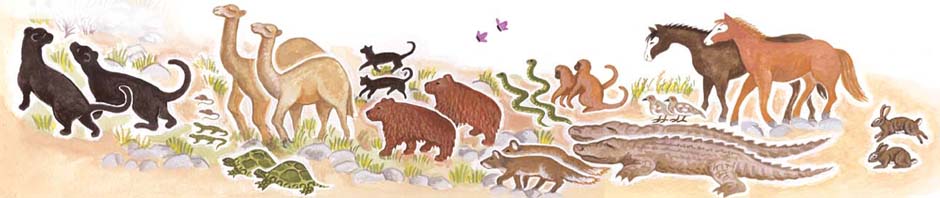
It’s always a pleasure to paint on birch bark. The inner side, with the beautiful rusty color you see here, is my favorite. I do not peel it from the tree, but collect fallen curls of bark from the ground. This lovely specimen is from a tree on Westkill Mountain, near my home. Birch bark is tough and durable – once glued down on matboard, an excellent surface for water-based paint.
Starting with a medium-tone background makes it possible to work both lighter and darker. For me it’s a refreshing change to apply white on an earth-toned surface. Flat color is best on birch bark’s smooth texture, which is why I chose a naive style and simple composition – fitting for the subject. I felt I was revisiting my earlier self as an artist, for as a youthful admirer of ancient and tribal art, I often worked in a flat, “primitive” style.
I was also revisiting my earlier self as a seeker. Before I was led to explore my Jewish heritage, the forest was my spiritual sanctuary. Returning there in my dream was no surprise, for there I drew to me the wild and gentle creatures in my psyche with a blast of the ram’s horn. The shofar announced to the forest that something new resounded in my soul, something big enough and old enough to encompass both humanity and nature. Very pleased I was to find throughout Jewish liturgy blessings and psalms and readings in honor of the earth and our connection to it. The blessing for dew might be my favorite.
Now I walk in the woods to practice Torah and Haftarah readings in that shelter of peace beneath the branches. I believe the animals – and even the trees – listen.
–––––
Thank your for reading “The Stories Behind the Pictures”. If you have not already read the captions in the calendar which these stories accompany, you may do so by ordering the calendar through my webstore or on Amazon. (Please order directly from my webstore! Amazon takes a big cut.) To view the entire calendar, click here.
I am also the author/illustrator of half a dozen Jewish-themed children’s books, two of which have won the prestigious Sydney Taylor award: Around the World in One Shabbat; Never Say a Mean Word Again: A Tale from Medieval Spain; The Life of an Olive; The Dreidel That Wouldn’t Spin; Love Is (though not explicitly Jewish, a celebration of Ahava Raba – great love); Green Bible Stories for Children; and forthcoming next year in time for Purim, Esther’s Gragger (not yet on my website).
Thank you for your interest in my art!
